Revolution in recycling
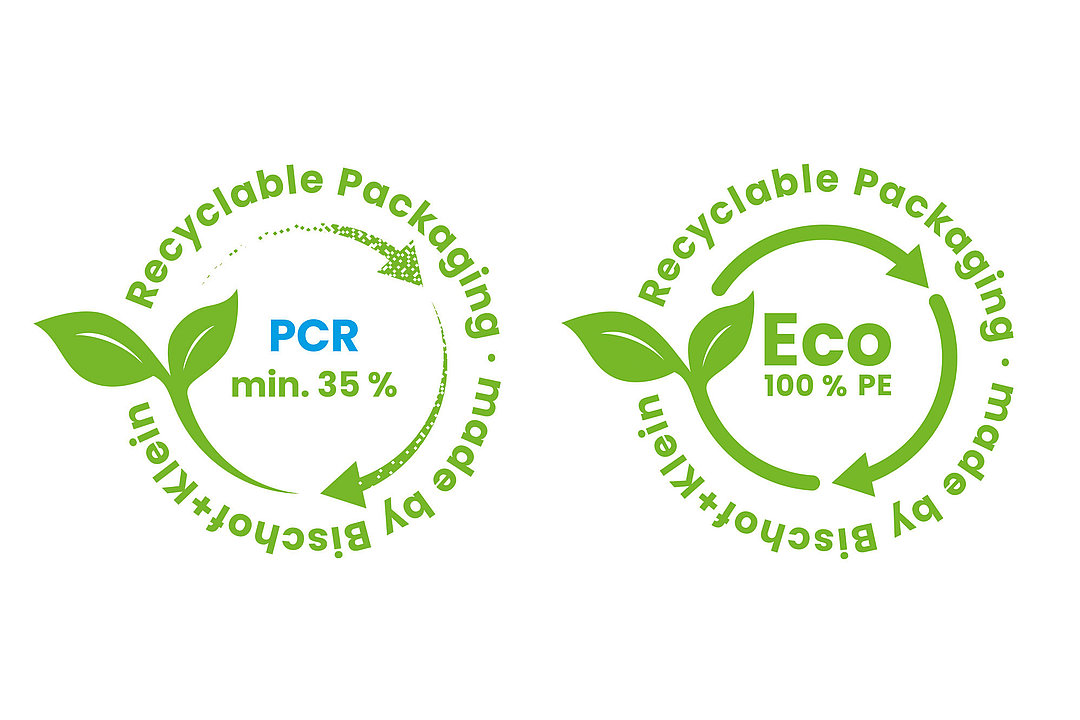
Our Eco logos for recyclability and use of recyclate
Laser marking and digital product passports
How do laser marking and the digital product passport help to improve the recyclate quality of plastic films and enable a genuine circular economy? The answer to this question is being provided by a cross-industry project in which Bischof+Klein has taken part with a multi-ply plastic sack made of polyethylene (PE). The packaging material identification was integrated directly into the film using a laser. This makes segregated recycling easier.
Plastics are a blessing – and a global problem. Light, durable, and with diverse applications. However, it is precisely these characteristics that are making plastics a global challenge. Over 400 million metric tonnes of them are produced each year. Only around nine percent are recycled. The remainder is dumped in landfills, burnt, or ends up in the environment.
Bischof+Klein has set itself the goal of integrating its products completely into the circular economy. The recyclability of our films and the use of recyclate in manufacturing them are the prerequisites for this.
At the same time, we are working towards increasing the use of recyclates. To ensure that this succeeds, we require high-quality recyclate.
Where is the problem in recycling?
The use of mono material is sensible for both chemical and mechanical recycling. Good separation and sorting of the different types of plastic additionally improve the quality of the recyclate. Reliable labelling is necessary for this.
However, ink and labels pose a problem during recycling, as they are often thermally unstable. They burn at the high temperatures prevailing in the extruder. Besides changes in color, this also frequently leads to unpleasant odors. Ink and labels can be forgone with laser marking.
Labelling with light
In laser marking, the identification is not printed or glued on, but is integrated directly into the material. This is made possible by special pigments that are contained in the plastic. The laser causes a change to a dark color due to the pigments' reaction to the energy-rich laser light. High-definition contrasts are produced. The marking is permanent, hygienic, resistant to abrasion, and requires neither ink nor adhesive.
However, colored printing motifs or complex graphics cannot be achieved using lasers. If color brand designs are required, dyed plastics can be used or laser marking can be combined with other techniques. However, laser marking is already the best choice for numerous applications, particularly in the industrial sector.
Bischof+Klein has the solution:
A multi-ply plastic sack from Bischof+Klein served as an example of implementation. The film for this is available both completely with new polyethylene (PE) and also with at least 35 percent PCR (post-consumer recyclate). In each case, the PE is 100 percent recyclable.
Incidentally, using at least 35 percent PCR improves the PCF (product carbon footprint) by around 20 percent. This packaging solution already meets the requirements of the new European Packaging and Packaging Waste Regulation (PPWR regulation) for 2030.
The laser-sensitive marking is located in the outer layer of the film. Tests have shown that the marking is maintained even after multiple recycling cycles and does not negatively affect the quality of the recyclate. In a technical center test, films were extruded, lasered, and extruded again. The marking remained stable during this process without negatively affecting the mechanical properties of the film.
Industry 4.0 vision: digital twin and circular economy thanks to laser labelling
Machine-readable labelling smoothes the way to a genuine circular economy. Many manufacturers are already working with digital twins, i.e., virtual images of their production lines and products. They provide material data, life cycle information, and recycling suitability. In the context of the project, this data structure is used to couple the physical laser label seamlessly with a digital product passport (DPP). Even during manufacturing, each bag is therefore given a digital twin that is updated over several life cycles.
Laser-based, data-linked labelling enables all important production data, recycling cycles, and material analyses to be automatically registered and fed back within an Industry 4.0 environment. This gives rise to an intelligent material flow from manufacturing and use to return to the circular system.
Categories
- Foreword (1)
- News (4)
- Title topic (3)
- Innovations from Bischof+Klein (2)
- Packaging trends (1)
- Megatrends (1)
- We at Bischof+Klein (3)
- Our locations – Bischof+Klein Lengerich (6)
- Our locations – Bischof+Klein Konzell (6)
- Our locations – Bischof+Klein France (1)
- Our locations – Bischof+Klein Polska (4)
- Our locations – Bischof+Klein UK (4)
- Last but not least (1)
- article overview