Focus on climate protection
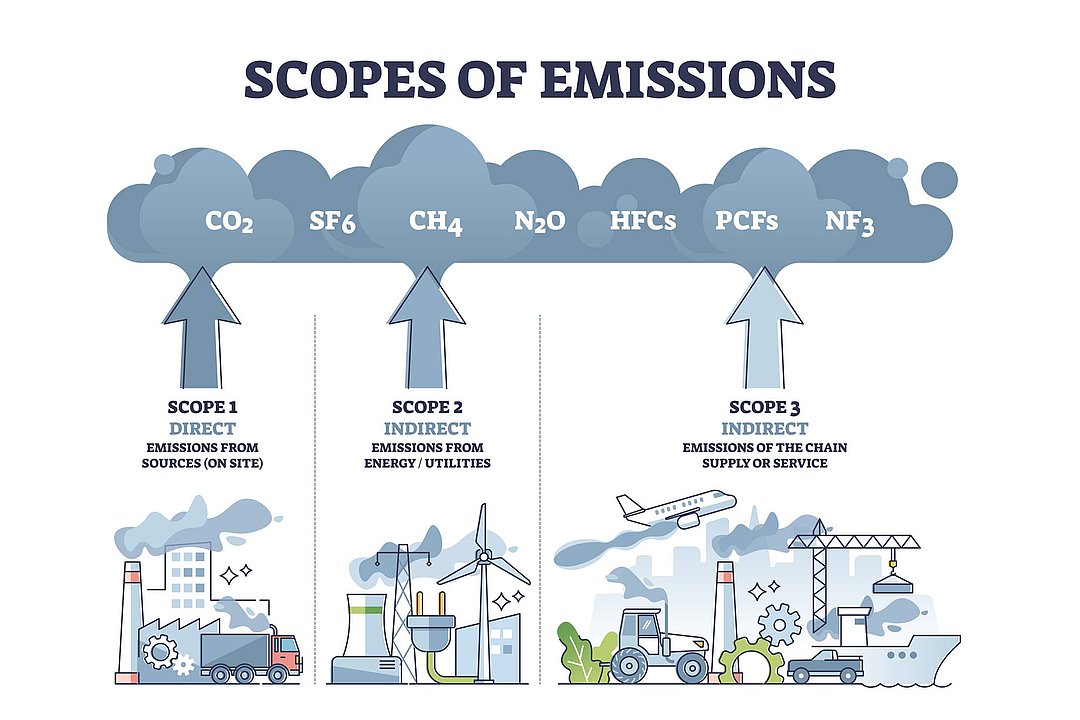
How Bischof+Klein calculates its carbon footprint.
How much greenhouse gas does Bischof+Klein produce when manufacturing its films and packaging? The answer to this question is complicated. Our new colleague Julia Walman, an employee in the purchasing department, is dealing intensively with this topic and explains to us what approach Bischof+Klein takes in this regard:
“We use the terms scope 1, scope 2, and scope 3 in what is called carbon footprinting. These are used to classify the various sources of emissions. Scope 1 encompasses direct emissions that originate from a company’s own lines and vehicles. Scope 2 refers to indirect emissions caused by the consumption of purchased energy, such as electricity and heat.
The focus at Bischof+Klein is currently on scope 3, as this comprises the most extensive emissions that are often the most difficult to quantify.
Scope 3 encompasses all indirect emissions that occur along a company’s entire value chain, including emissions caused by the production of raw materials, the use of products, and their disposal. These emissions can make up a significant part of a company’s overall carbon footprint and are therefore of crucial importance for the development of sustainable strategies and thus for Bischof+Klein's strategy.
In order to take initial steps towards collecting scope 3 data, the purchasing department has decided to join an action group of a start-up called “The Climate Choice.” Together with other companies, we are tackling the challenge of collecting scope 3 data.
On the whole, taking scope 3 into consideration in the supply chain is crucial in order to achieve climate targets and meet the requirements of the PPWR. As a company that is proactively working to reduce its scope 3 emissions, Bischof+Klein is not only positioning itself as a proponent of the importance of sustainability, but is in a sense ensuring that it has a competitive advantage in an increasingly environmentally-aware market landscape.”
Categories
- Foreword (1)
- News (6)
- Title topic (2)
- Innovations from Bischof+Klein (3)
- Packaging trends (1)
- Megatrends (1)
- We at Bischof+Klein (3)
- Our locations – Bischof+Klein Lengerich (5)
- Our locations – Bischof+Klein Konzell (8)
- Our locations – Bischof+Klein France (4)
- Our locations – Bischof+Klein Polska (5)
- Our locations – Bischof+Klein UK (4)
- Last but not least (1)
- article overview