Competence and growth
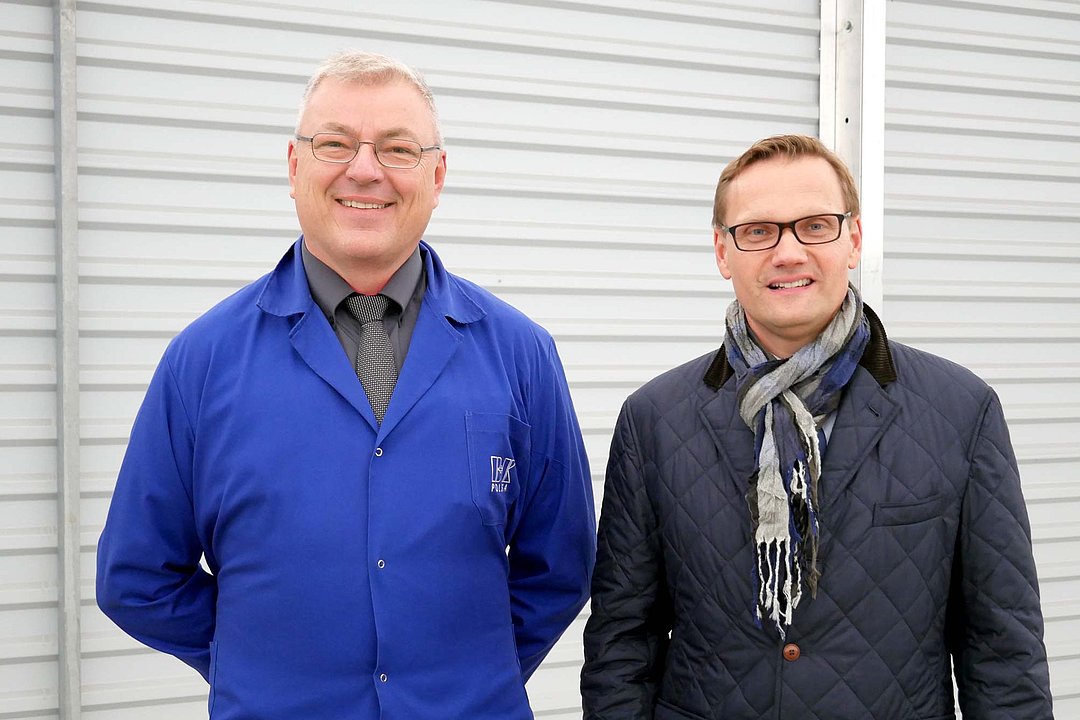
From the left: Ginter Maicher and Karsten Pax at the 2017 anniversary in Walce
Plant manager Ginter Maicher takes a look back
After 24 years at Bischof+Klein Polska, plant manager Ginter Maicher (M) is embarking on his well-deserved retirement. In an interview, he looks back together with Karsten Pax (P), managing director of Bischof+Klein Polska.
Mr. Maicher, you were the first plant manager in Walce and have been in office since April 1, 2002. How did you arrive at Bischof+Klein?
M: That was back in January 2001. At that time, I was managing a plant for paper sacks in Krapkowice, not far from Walce. In January 2001, an acquaintance visited me with the first plastic sack produced in a new factory in Walce. I was very interested in that and it appeared to offer new prospects. So I applied for the position of plant manager. After several meetings with Dr. Volker Pfennig, I took over the position on November 1, 2001.
Bischof+Klein Polska Sp.z o.o. was founded in 1999 and construction of the plant in Walce began the following year. What was the situation like at that time?
P: We started off with a small hall and used machines from our German plants. The idea was to produce standard films and packaging under low-cost conditions. We had our sights set on the Eastern European market.
Mr. Maicher, which defining experiences do you recall from this initial period?
M: The first priorities at that time were to recruit and train people, to increase quality and production and to expand our activities on the Polish market. All of this together with our colleagues from Lengerich and Konzell.
P: Intensive dialogue with our German colleagues must have taken place. I'm just thinking of a photograph that is hanging on the wall in Walce. It shows German and Polish colleagues standing next to the AD Plastic.
Which products did Bischof+Klein Polska start off with?
M: Valve sacks, flat sacks, and one year later, also FFS films.
How many employees did you have in the beginning?
M: We started off with around 40 people. The team grew successively due to the increasing number of orders from Germany and therefore increasing production.
When were further products added?
M: Once we had increased production volumes and quality, we were able to install additional machines. The second AD Plastic line was added in 2004, but also lines for the FFS and then the SH departments. We used an initial regranulation line to enable us to use our own regranulate from production waste for our products virtually from the word go, in 2002.
What was the situation like after ten years?
M: During the first ten years, we experienced a continuous increase in inquiries, sales volumes, and employees. All of this was extensively linked to our parent company in Lengerich.
P: In 2010, the company generated sales of around 24 million euros and employed 120 people.
The following year, you took over as managing director from Horst Weber, who had held that position until then. Which measures did you implement in your new position?
P: We specifically modernized and successively expanded the plant. We did that in several steps: extrusion, semifinished goods warehouse, finished goods warehouse, recycling center, and then the construction of the big new hall in 2023/24.
Which milestones were there?
M: Important events for the plant included the purchase of the second AD Plastic line in 2004 and subsequently the new extruders and the printing presses. Increasing the size of the site from 4.6 to its present size of around 10 hectares was the prerequisite for further growth. And finally, the extension in 2023, called Walce II.
How many employees do you have today and what sales do you generate?
M: In 2024, we generated sales of 70 million euros and the number of employees was around 280. Today, around 300 of our own staff are employed in Walce.
Mr. Pax, how would you describe the collaboration with Mr. Maicher and your Polish colleagues?
P: It's very good. I have come to appreciate Ginter Maicher very much. You could say that Bischof+Klein Polska is an important part of his life. It’s his “child.” On the whole, I feel comfortable in Walce. It's a familiar feeling for me to be here.
What would you like to pass on to Mr. Maicher as he enters retirement?
P: I would like to wish him the very best, good health, and lots of enjoyment with his sporting activities such as hiking, cycling, and swimming. And I hope that we remain in contact. After his retirement in July, he will continue to work in an advisory capacity until the fall.
Mr. Maicher, what would you like to pass on to your successor Leszek Demciuch?
M: Good cooperation with the team is very important. This particularly applies in the current times, when good employees are not so easy to find. Our continuous improvement projects in the areas of production and productivity are indispensable. They will continue to drive our plant forwards. I would also like to wish him continued good and intensive collaboration with the entire Group and, of course, with his colleagues at Bischof+Klein's Lengerich headquarters.
What prospects do you see for the Walce plant?
M: I see very good prospects for Bischof+Klein Polska. Plastic industrial packaging will remain indispensable in the future. The plant is well prepared for growth and for increasing customer requirements.
P: Bischof+Klein Polska is a central pillar within the Group. The plant has developed into a center of excellence for valve sacks and stretch hood films. I can still see a great deal of potential for growth here.
Categories
- Foreword (1)
- News (6)
- Title topic (2)
- Innovations from Bischof+Klein (3)
- Packaging trends (1)
- Megatrends (1)
- We at Bischof+Klein (3)
- Our locations – Bischof+Klein Lengerich (5)
- Our locations – Bischof+Klein Konzell (8)
- Our locations – Bischof+Klein France (4)
- Our locations – Bischof+Klein Polska (5)
- Our locations – Bischof+Klein UK (4)
- Last but not least (1)
- article overview